Creative Father’s Day Print-on-Demand Ideas That Customers Will Love
June 3, 2026
Print-on-Demand Posters: A Powerful Tool for Branding, Revenue, and Business Growth
July 23, 2026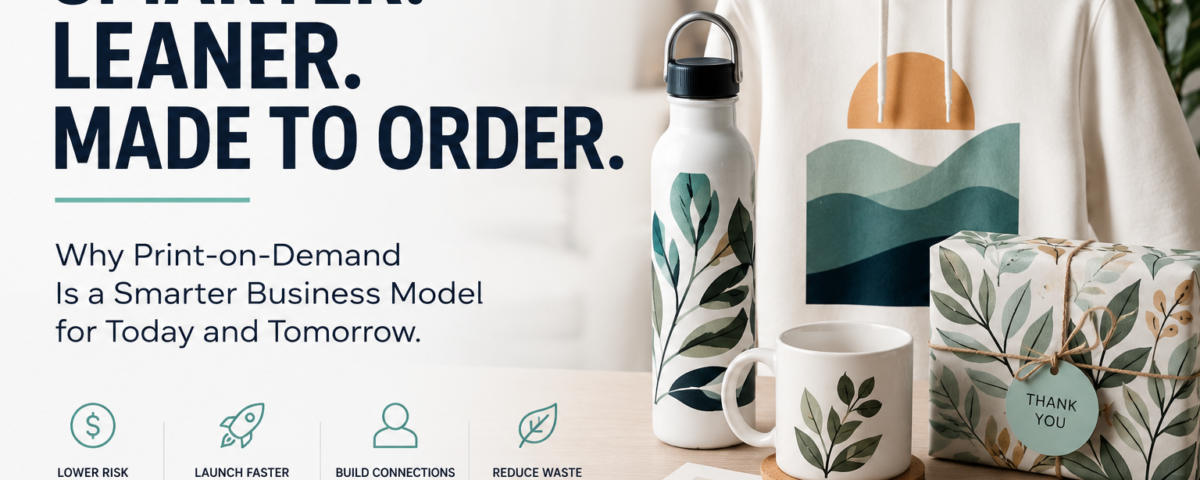
For years, starting a product-based business meant making a difficult choice: invest heavily in inventory and hope demand follows, or stay small and limit growth.
Today, Print-on-Demand (POD) has changed that equation!
What started as a simple way to sell custom t-shirts has evolved into a sophisticated business model powering branded merchandise, creator businesses, e-commerce stores, corporate gifting, event marketing, home décor, stationery, packaging, and specialty products. And in a market where agility matters more than scale, POD may be one of the smartest ways to launch, test, and grow a product business.
What Is Print-on-Demand?
Print-on-Demand is a fulfillment model where products are created only after an order is placed.
Instead of purchasing large quantities upfront, businesses upload designs, connect a storefront, and have products produced and shipped individually as customers buy.
The result: fewer upfront costs, less waste, lower operational complexity, and more flexibility to experiment.
But the real advantage isn’t convenience, it’s adaptability.
Why POD Makes More Sense in Today’s Market
1. Inventory is expensive. Ideas are not. Traditional retail rewards prediction. POD rewards experimentation.
Businesses no longer need to forecast demand six months in advance or warehouse products that may never sell. Instead, they can launch quickly, gather real customer feedback, and expand based on actual buying behavior.
For startups and established brands alike, this lowers risk dramatically.
A seasonal collection? Test it. A niche audience? Launch it. A corporate campaign? Produce exactly what’s needed.
The barrier to entry has never been lower.
2. Consumers Expect Personalization
Customers increasingly want products that feel specific to them, not mass-produced.
POD supports this shift naturally.
Brands can create:
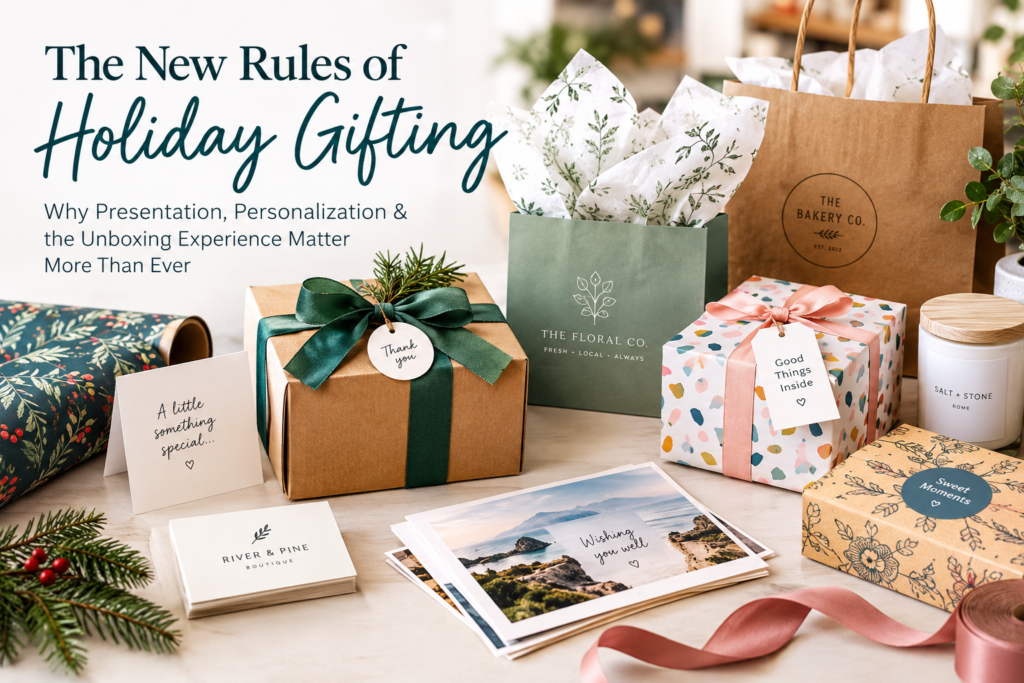
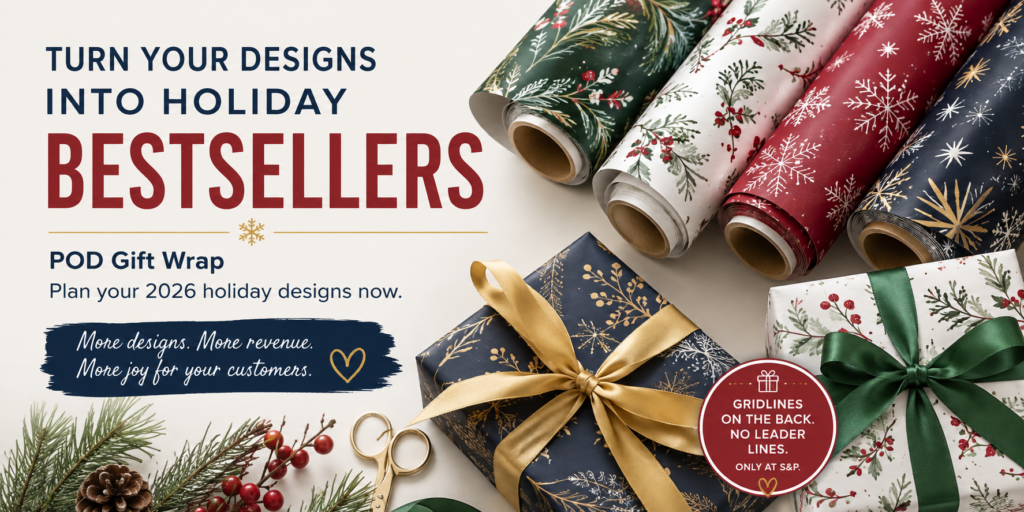
- Personalized gift wrap
- Event-specific signage
- Custom stationery
- Limited-edition posters
- Regional or audience-specific campaigns
- Branded packaging experiences
- Seasonal product drops
- Small-batch product collections
Instead of one design for everyone, businesses can create dozens, or hundreds, of targeted variations.
That flexibility creates stronger customer engagement and often improves conversion rates.
3. Businesses Can Move at the Speed of Trends
Trend cycles are faster than ever. By the time traditional production catches up, attention may already have moved elsewhere. POD enables businesses to respond in days rather than months. A local event, holiday moment, cultural trend, customer insight, or new campaign can become a product opportunity almost immediately. That responsiveness turns marketing into commerce.
4. Better Margins Aren’t Always About Lower Costs
One misconception about POD is that it only works because it avoids inventory. In reality, the greater advantage lies in operational efficiency.
Businesses reduce:
- Unsold stock
- Storage costs
- Packaging overhead
- Order management complexity
- Production forecasting errors
Teams can spend more time on product design, customer experience, and growth rather than on logistics. For many companies, that trade-off matters more than maximizing per-unit margin.
5. POD Supports Sustainable Business Decisions
Consumers are paying more attention to overproduction and waste. Because products are produced only when purchased, POD naturally reduces excess inventory. That doesn’t automatically make every POD operation sustainable, but it does align with a broader shift toward producing to demand rather than guessing it. For brands looking to operate more intentionally, that’s becoming increasingly valuable.
The Categories Seeing Momentum Beyond Apparel
When people hear ‘POD,’ they often think of clothing first.
But some of the most interesting growth opportunities are happening elsewhere:
- Gift wrap and premium gifting
- Posters and wall art
- Cards and stationery
- Home décor and table runners
- Corporate and employee gifting
- Branded packaging inserts
- Event and celebration products
- Educational and organizational materials
- Retail display and promotional materials
These categories create repeat purchase opportunities and allow brands to expand without adding operational burden.
The Future of POD Isn’t Small Businesses, It’s Smarter Businesses
Print-on-Demand is no longer simply a side hustle model. It’s becoming a strategic operating model. Established companies use POD to test markets before committing inventory. Agencies use it to extend campaigns into physical products. Creators use it to diversify revenue. Small businesses use it to compete with larger brands. The businesses that win over the next few years may not be the ones producing the most. They may be the ones producing only what customers actually want. That’s where Print-on-Demand stands out, not as a shortcut, but as a smarter way to build.